In the pursuit of more intelligent and convenient modern life, wearable devices play an increasingly important role. However, as an important part of wearable devices, batteries have always limited the design innovation and user experience of devices. Problems such as frequent charging, short battery life, and waste disposal have made people full of expectations and doubts about the future of wearable devices. Recently, a team of researchers at Carnegie Mellon University has successfully developed a technology called "Power-over-Skin", which can use the radio frequency energy generated by the human body to power wearable devices, which is expected to completely break away from battery dependence and open a new era of wearable devices.
1. Technical Principles and Applications
The core of the "Power-over-Skin" technology is the use of the body's own generated radio frequency energy, which mainly comes from the electromagnetic activity inside the human body, such as heart beating, muscle contraction, etc. These activities generate weak RF signals, and it is through a special "receiver" that the "Power-over-Skin" technology captures these signals and converts them into power to power the wearable.
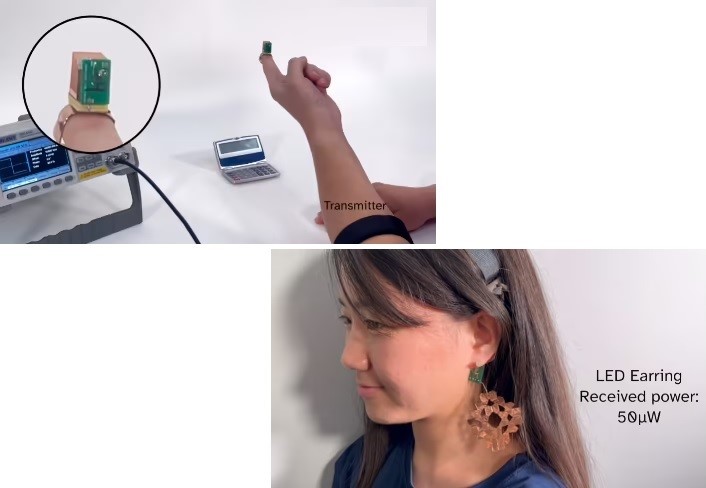
Figure: Carnegie Mellon University's "Skin Powered" technology enables 1.53 mW power transfer
The unique design of the receiver of this technology is not only capacitive enough to easily penetrate clothing and achieve a tight fit to human skin, but its small size is expected to be integrated into a wider range of devices such as smartphones and smartwatches in the future, making it truly battery-free.
Researchers have demonstrated the feasibility of this technology using a variety of devices. For example, they have developed a Bluetooth ring with a joystick, powered by "Power-over-Skin" technology, which allows users to control devices such as mobile phones and computers with simple gestures; There is also a medical patch that records the user's health data, which can monitor the user's heart rate, blood pressure and other physiological indicators in real time, and send the data to the mobile phone or cloud through wireless means; In addition, they have developed a sunscreen patch with a screen that not only provides sun protection, but also displays useful information such as time of day and weather. In the future, this technology can also be applied to new wearable devices such as VR/AR headsets and smart glasses, bringing users a richer and more convenient experience.
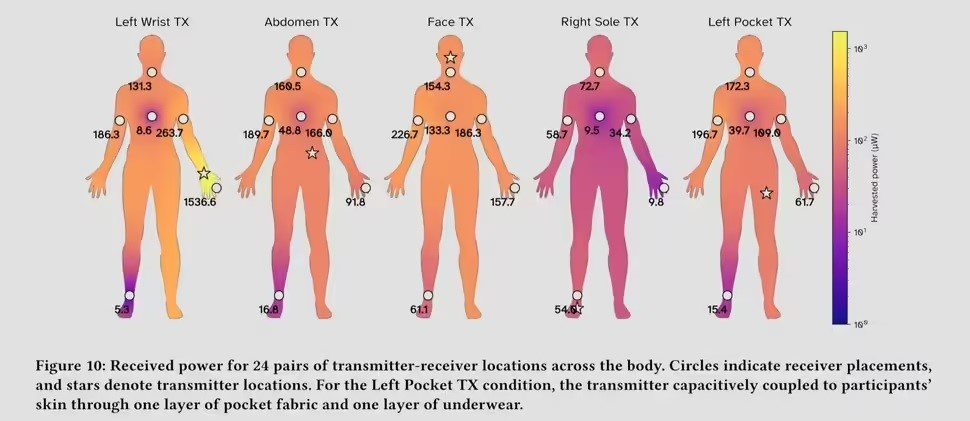
Figure: Researchers have found that the human body is able to efficiently produce 40 MHz of RF energy
2. Technical advantages and market potential
The biggest advantage of the "Power-over-Skin" technology is its ability to power almost any wearable device, eliminating the need for batteries. This not only reduces the weight and size of the device, making the wearable device thinner and more stylish, but also reduces the dependence on finite resources such as rare earth minerals, making it more environmentally sustainable.
While this technology is still in its early stages, the market potential is huge. With the increasing demand for wearable devices and the continuous maturity and improvement of technology, it is believed that "Power-over-Skin" technology will occupy a place in the wearable device market in the future. It can power a wide range of wearable devices, from simple watches, necklaces to complex fitness trackers, medical devices, and perhaps even expand to smart homes, smart transportation, and more. Of course, due to the limited amount of energy produced by the human body, the scope of application of this technology is mainly limited to devices with relatively low power consumption.
3. Experimental results and efficiency
In order to verify the feasibility and efficiency of the "Power-over-Skin" technology, the researchers conducted a large number of experimental tests. They chose four different emitter positions: the sole of the right foot, the abdomen, the left wrist, and the face (which may be suitable for face-worn devices such as AR/VR headsets). For each transmitter position, they set up six different receiver positions: right ankle, back of the neck, sternum, left and right biceps, and left index finger, which are often common wearing positions for wearables.
The experimental results show that when the distance between transmitter and receiver is the shortest, the average power of the device is the highest, reaching 1.53 mW. At longer distances, the average power is relatively low, with a minimum of 5.3 μW. In addition, the researchers also found that although the "Power-over-Skin" technology can transmit energy through clothing, the transmission efficiency will be affected to some extent. Therefore, in order to ensure the best transmission effect, it is recommended to keep the transmitter and receiver as close as possible when using.
4. Editor's Views & Observations
As a science and technology observer, China Exportsemi deeply feels that the emergence of "Power-over-Skin" technology is a major technological innovation and energy utilization revolution. It not only solves the problem of battery life of wearable devices, makes the device more convenient and comfortable, but also promotes the in-depth practice of environmental protection concepts in the field of science and technology. I believe that as this technology continues to evolve and improve, it will play an increasingly important role in the future wearables market, bringing users an unprecedented experience.
5. Conclusion
Carnegie Mellon University's "Skin-Powered" technology undoubtedly lays a solid foundation for the future of battery-free wearables. Not only does it demonstrate the feasibility of using the RF energy generated by the human body to power devices, but it also opens up new possibilities for wearables that are lighter and more convenient in the future. With the further development and refinement of technology, we have reason to believe that wearables will enter a new era – an era of more freedom without batteries. In this era, wearable devices will no longer be a burden that binds us, but will become an indispensable assistant and partner in our lives to create a better future together.