In the global semiconductor industry, 7nm chip technology represents the most advanced manufacturing process available and is essential to improve chip performance and reduce power consumption. With the news that TSMC and Samsung may stop supplying 7nm chips to Chinese mainland, this incident has aroused widespread concern in the global industry. It not only affects the global semiconductor supply chain, but also brings great challenges to the semiconductor industry in Chinese mainland. China Exportsemi will try to analyze this time from multiple angles and provide you with some ideas.
1. Technical background and market analysis
7nm process chips are at the forefront of semiconductor technology and are the key for major technology companies to improve chip performance and reduce power consumption. TSMC and Samsung are global leaders in semiconductor manufacturing, and their advanced manufacturing processes occupy an important position around the world. In recent years, with the rapid development of artificial intelligence, 5G communications, and high-performance computing, the demand for 7nm and below processes has increased dramatically, and it has become an important technology that global technology companies rely on.
TSMC has decided to suspend the supply of chips with 7nm and below processes to AI and GPU chip customers in Chinese mainland from November 11, 2024, a move that is undoubtedly a major blow to Chinese mainland's high-tech industry. At the same time, Samsung has adopted a similar strategy, shutting down some production lines and reducing supplies to the mainland market, which has exacerbated industry concerns about the stability of the supply chain.
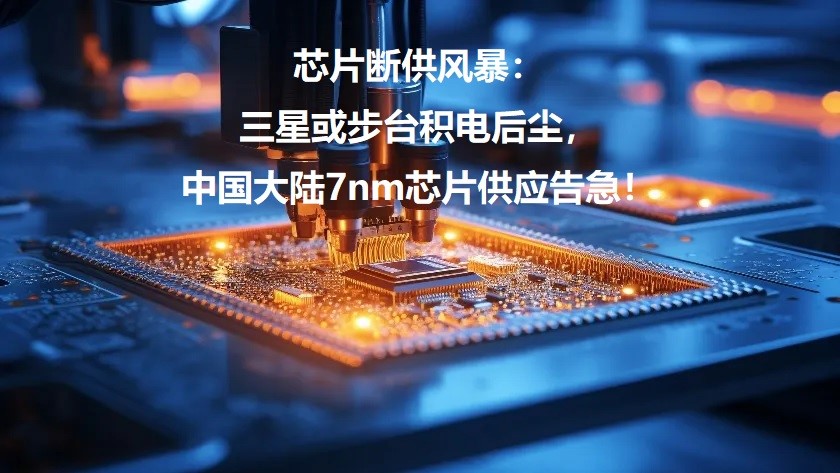
Figure: Samsung May Follow TSMC's Path as China's 7nm Chip Supply Faces a Crisis
2. the far-reaching impact of the supply chain and the response strategy of Chinese mainland
TSMC and Samsung's decision to cut off supply has had a profound impact on the global semiconductor industry landscape, especially on the Chinese mainland market. TSMC is the world's largest and leading semiconductor foundry, and the suspension of the supply of 7nm and below process chips means that Chinese mainland's AI, GPU and high-performance computing fields will face a huge supply gap. According to TSMC's latest financial report data, Chinese mainland customers contribute about 11% to 13% to it, and the suspension of supply of 7nm and below processes will cause TSMC to lose about 5% to 8% of its revenue, which should also indicate that this move is causing a chain reaction in the global semiconductor industry. According to reports, Samsung has shut down some of the production lines at Pyeongtaek 2 and 3 plants, covering 4nm, 5nm and 7nm processes. Samsung is expected to further expand the closure to 50% by the end of the year, a series of actions that show that Samsung is also preparing for supply cuts.
In the face of such a body, manufacturers are accelerating the pace of independent research and development, especially in the technological breakthrough of 7nm and below process technology. Companies such as Huawei HiSilicon, YMTC, and Tsinghua Unigroup are increasing their investment in next-generation chip technologies in an effort to reduce their dependence on external supply chains. Despite this, there is still a certain gap between Chinese mainland and international giants such as TSMC and Samsung in terms of production capacity and technical level of high-end chips, and how to break through these technical bottlenecks has become a top priority for China's semiconductor industry.
3. Specific data examples and market changes
TSMC and Samsung's supply cut-off measures not only affected their own business, but also triggered the adjustment of the global industrial chain. According to TSMC's financial report, Chinese mainland customers contributed 11% to 13% of TSMC's revenue in 2023. TSMC expects to lose at least 5% to 8% of its revenue amid the suspension of supply for 7nm and below processes. This figure not only represents the supply chain crisis of TSMC's financially damaged industry.
At the same time, Samsung Electronics expects its global chip supply chain to face further contraction after shutting down some production lines. In particular, the shutdown of Samsung's production lines for 4nm, 5nm and 7nm chips will further tighten the supply of high-end chips around the world. For Chinese mainland's AI, GPU and smart terminal industries, the lack of high-end chips will bring serious challenges.
4. Domestic semiconductor manufacturers respond
In the face of the news of TSMC and Samsung's supply cut, the semiconductor industry in Chinese mainland urgently needs to accelerate technological innovation and industrial upgrading. At present, domestic semiconductor manufacturers are actively seeking alternatives, including accelerating the research and development of domestic high-end chips. Taking Huawei HiSilicon as an example, HiSilicon has already made certain technological breakthroughs in the field of AI chips and high-performance computing, and its latest Kirin chip is being further optimized and mass-produced. However, despite technological progress, there is still a large gap in domestic process technology of 7nm and below.
Domestic foundries, such as SMIC and YMTC, are also investing heavily to promote the development of advanced process technologies through independent R&D. However, due to technical bottlenecks, the current domestic semiconductor manufacturing level is still unable to compete with leading manufacturers such as TSMC and Samsung.
Therefore, the semiconductor industry in Chinese mainland needs to continue to invest in basic research, materials science and chip manufacturing processes, while strengthening cooperation with the world's leading semiconductor manufacturers to improve its own technology research and development capabilities. Through independent innovation and technological breakthroughs, Chinese mainland is expected to gradually reduce its dependence on external technologies and provide important support for the supply chain restructuring of the global semiconductor industry.
5. Observation and prospects
From a global perspective, this event reveals the fragility of the semiconductor industry chain and the far-reaching impact of geopolitics on technological innovation and supply chains. For Chinese mainland, the current challenge is not only a crisis, but also an opportunity to accelerate independent innovation and enhance the resilience of the industrial chain. By increasing investment in semiconductor R&D and improving its own design and manufacturing capabilities, China has the potential to occupy a favorable position in the global semiconductor competition in the future.
In addition, this incident also reminds the global semiconductor industry that it needs to pay more attention to the diversification and stability of the supply chain. In the context of globalization, how to deal with the risks brought by geopolitics while ensuring the stability of the supply chain will become an important issue that all semiconductor companies must face.
6. Conclusions
With TSMC and Samsung announcing the end of the supply of 7nm and below process chips to the Chinese mainland market, the global semiconductor industry is facing unprecedented challenges. This incident not only affected the stability of the global chip supply chain, but also brought a new test to the semiconductor industry in Chinese mainland. For Chinese mainland, this is an opportunity to accelerate independent innovation and improve the resilience of local supply chains. In the face of the restructuring of the global semiconductor industry, Chinese mainland must accelerate technological breakthroughs and increase industrial investment in order to occupy a favorable position in future global competition.
Today, with the increasing cooperation of the global semiconductor industry, the export control measures of the United States will undoubtedly have a profound impact on the global semiconductor supply chain. In the future, how to maintain the stability and flexibility of the supply chain in the context of globalization will be a major issue that all semiconductor companies need to face.