The launch of the Huawei Mate70 series (related reading: Pre-orders for Huawei Mate70 Series Open: Unmatched Global Buzz, Meet the Ultimate Mate on the 26th.) It is not only another impact on the high-end smartphone market, but also an all-round demonstration of China's local industrial chain collaboration capabilities. Through in-depth localization, diversified supplier cooperation, and technological innovation, Huawei has demonstrated strong market resilience under the pressure of international sanctions. China Exportsemi will focus on the localization layout of the supply chain, core technology and innovation, market positioning and the future impact of the industrial chain.
1. Supply chain localization: from catching up to leading
The localization rate has been improved in an all-round way
The Mate70 series continues the strategy of high localization rate, relying heavily on domestic suppliers from core chips to peripheral components. For example, the production of Kirin 9000S chips is entirely based on the domestic supply chain system, including SMIC's 7nm process technology support. This technological breakthrough shows that China's semiconductor industry has achieved a partial lead in the process of "de-beautification".
In terms of screen, CSOT (a subsidiary of TCL Technology) supplies high-end OLED displays for the Mate70, and its inkjet printing technology and LTPO display technology achieve a higher refresh rate and power consumption balance, providing Huawei with differentiated competitiveness.
Diversification of the supplier
Huawei has established in-depth cooperative relations with leading domestic suppliers such as Luxshare Precision, BOE, and Sunlord Electronics. In terms of key components, Sunlord Electronics provides advanced RF module solutions, while Luxshare Precision is responsible for the manufacturing of some precision components. These collaborations not only diversify supply risks, but also improve the flexibility of Huawei's supply chain.
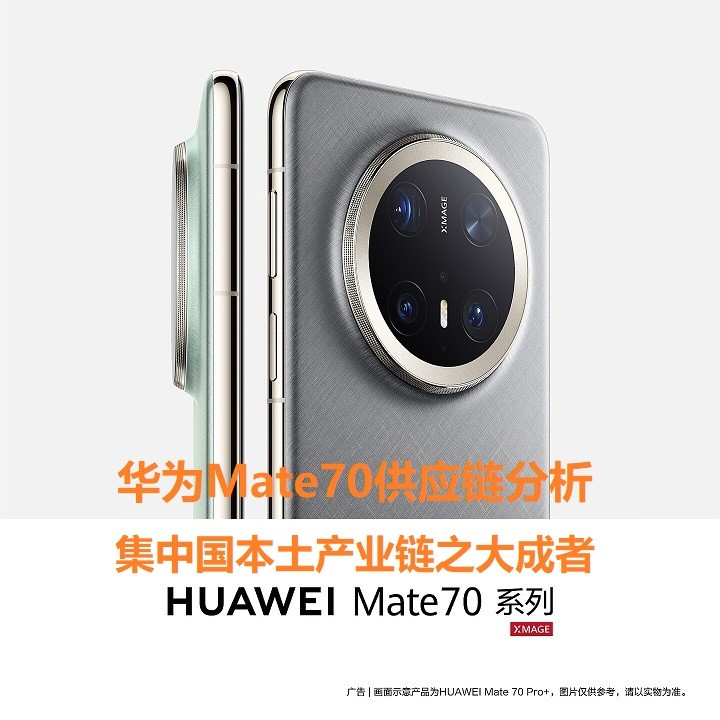
Figure: Supply chain analysis of Huawei Mate70
2. Core technology innovation: self-research and cooperation go hand in hand
The strategic significance of Kirin chips
The Kirin 9000S chip is one of the core competitiveness of the Mate70 series. This chip not only represents Huawei's self-research capabilities, but also carries the collective wisdom of the domestic semiconductor industry chain. It uses the most advanced process in China, supports 5G communication and optimizes AI computing performance. This allows the Mate70 series to compete in performance with the world's leading high-end models, such as the Apple iPhone 15 Pro Max.
Communication technologies and the HarmonyOS ecosystem
The support of 5.5G technology enables the Mate70 to have higher network speeds and lower latency, especially in IoT scenarios. In addition, HarmonyOS 4.0 has been further improved to provide users with a seamless multi-device collaboration experience. By building a closed ecosystem loop, Huawei has taken a different path from international brands in the direction of system and hardware integration.
The overall improvement of the manufacturing process
Through the cooperation with SMIC, Huawei has not only optimized the chip manufacturing process, but also extended the application of the technology to peripheral devices and modules. For example, breakthroughs in battery technology have led to an increase in energy density, giving the Mate 70 a longer range.
3. Market positioning: the road to revival from domestic to global
The re-competition for the high-end market
The Huawei Mate 70 is positioned at the top end of the Chinese market, and its starting price is comparable to Apple's iPhone series, reflecting Huawei's confidence in the brand's ability to premium the brand. According to the data, the sales of Huawei's Mate60 series have exceeded 10 million units, and the Mate70 series is expected to continue this growth trend.
Hope for the recovery of global markets
Despite the challenges facing the international market, Huawei is reshaping its globalization strategy through its presence in countries along the Belt and Road and emerging markets. For example, in markets such as the Middle East and Southeast Asia, Huawei's Mate series has gradually occupied a part of the share of high-end mobile phones by virtue of its high cost performance and technical advantages.
4. Future impact: the drive to the local industrial chain
Supply chain upgrades
Huawei's large-scale localization demand is a huge empowerment for domestic supply chain enterprises. For example, driven by Huawei, domestic enterprises have significantly increased their R&D investment in chip packaging, RF modules, and display technology. The improvement of technical capabilities of manufacturers such as Luxshare Precision and Weir will promote the overall upgrading of the entire industry.
Risks and challenges
Despite the high degree of localization of Huawei's supply chain, there are still concerns about over-reliance on a single market, such as China's domestic market. If the international situation or policy environment further complicates in the future, the flexibility and resilience of the supply chain still need to be strengthened.
5. Editor's Observations & Opinions
Through the supply chain analysis of the Mate70 series, it can be seen that Huawei is reshaping the smartphone industry pattern through the "autonomy + collaboration" model. Although its supply chain localization strategy was initially designed to cope with the pressure of sanctions, it has now become one of Huawei's competitive advantages. What's more noteworthy is that this model not only promotes Huawei's recovery, but also provides stable demand and technological innovation opportunities for the entire domestic supply chain.
However, there are also challenges. The recovery of the global market will take longer, and the rapid expansion of domestic supply chains will also need to avoid the risk of technology bubbles and overcapacity. In the long run, Huawei's success will depend on its continuous evolution in supply chain management, product innovation, and market layout.
6. Summary
The supply chain of Huawei's Mate 70 series is a "culmination" of China's local industrial chain. This not only represents the re-emergence of Huawei, but also marks the steady rise of China's smartphone supply chain in the international market. With the further integration of technological innovation and market demand, China is expected to compete more deeply with international brands in the field of high-end smartphones.
The breadth and depth of the article reflect Huawei's outstanding capabilities in the face of adversity, and at the same time inject more confidence and expectation into the future of China's technology industry.