There are reports that NVIDIA recently announced a partnership with Google Quantum AI to accelerate the design of next-generation quantum computing devices using the CUDA-Q platform. This collaboration marks an important step forward in the integration of quantum computing and AI supercomputing, opening up a new path to solving key challenges in the development of quantum hardware, reducing the associated time to minutes.
Overcome the "noise" problem of quantum hardware
Current quantum computing hardware is limited by "noise", which limits its ability to run quantum operations. Noise originates from the complex interaction of qubits with their environment, affecting the accuracy and scalability of computations. Noise is a significant technical challenge in quantum computing, often referring to inaccuracies or errors caused by external interference or inherent defects in the operation or storage of information by qubits.
Specifically, these "noises" mainly include the following aspects:
1. Ambient noise
Qubits are very sensitive and susceptible to the surrounding environment such as temperature fluctuations, electromagnetic interference, vibrations, etc. These external disturbances can disrupt the superposition and entanglement properties of quantum states, making the results unreliable.
2. Decoherence
Decoherence is one of the core problems in quantum computing. Qubits need to maintain a superposition state when performing calculations, but due to the inevitable interaction with the surrounding environment, the quantum state will gradually decay or deviate from expectations, resulting in a decrease in the accuracy of the calculation.
3. Door operation noise
In quantum computing, quantum gates are the basic units that perform operations. However, current quantum gate operations are not perfect and can accumulate into computational noise due to inaccurate operations due to hardware limitations or errors in the technical implementation.
4. Readout noise
In quantum computing, measuring the state of a qubit introduces additional errors. Inaccurate measurements or insufficient instrument sensitivity can result in the final output being deviated from the true value.
5. Thermal noise
The operation of qubits is usually carried out at extremely low temperatures (superconducting qubits used in quantum computers, such as those used in quantum computers, require conditions close to absolute zero) to minimize thermal perturbations. But even so, the random excitation caused by thermal energy still has an effect on the quantum state.
"The development of a commercial quantum computer is only possible if quantum hardware scales while controlling noise," said Guifre Vidal, research scientist at Google Quantum AI. "With NVIDIA accelerated computing, we are exploring the impact of noise in larger-scale quantum chip designs."
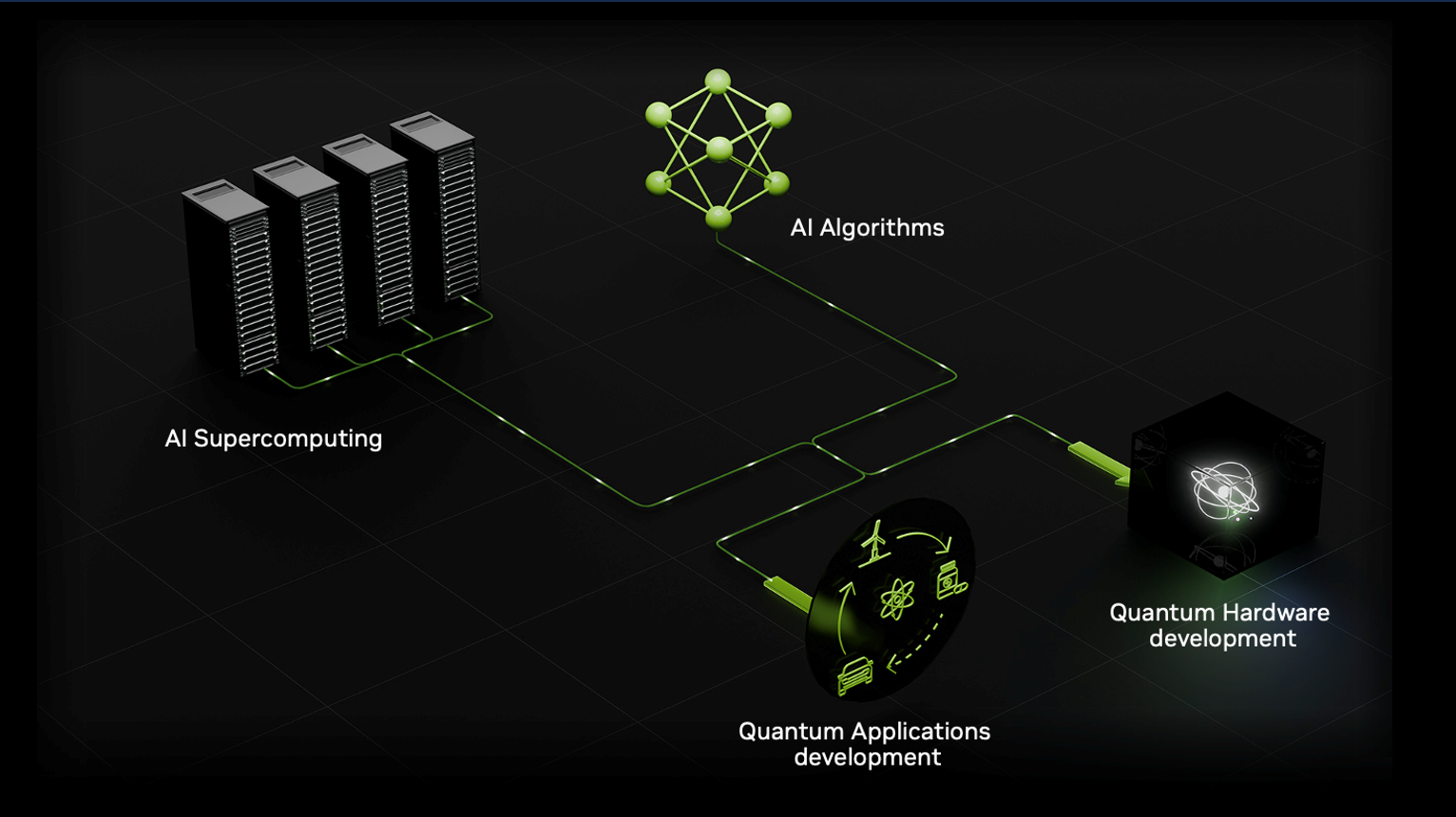
Figure: NVIDIA and Google Quantum AI join forces to drive new breakthroughs in quantum computing hardware design (Source: NVIDIA)
Powered by the NVIDIA EOS supercomputer
Google Quantum AI leverages 1,024 H100 Tensor Core GPUs from the NVIDIA Eos supercomputer to run the world's largest quantum device dynamics simulation. These simulations capture the interaction between the qubits and the environment, greatly improving the accuracy and efficiency of quantum hardware design.
With the CUDA-Q platform, Google has achieved a comprehensive simulation of a device containing 40 qubits, a scale that is currently the world record in the field. Complex noise simulations that would have taken a week can now be completed in minutes, significantly reducing computational costs and time.
AI supercomputing empowers the quantum future
"NVIDIA accelerated computing has demonstrated a central role in driving quantum computing success," said Tim Costa, director of NVIDIA's Quantum and High Performance Computing Division. "Google's application of the CUDA-Q platform demonstrates the importance of GPU-accelerated simulation in the development of quantum computing hardware."
The software tools will be open to the world
To drive the industry forward, NVIDIA plans to incorporate the software tools that support these simulations into the CUDA-Q platform and make them available to researchers and hardware engineers. The move will help quantum computing hardware developers around the world rapidly scale their system designs and drive a wider range of technological innovations.
Prospects for commercialization of quantum computing
This collaboration not only demonstrates the deep accumulation of NVIDIA and Google Quantum AI at the forefront of technology, but also further promotes the commercialization of quantum computing hardware. By fusing AI supercomputing with quantum simulation, future quantum computers are expected to achieve larger-scale, higher-performance computing power to solve real-world challenges, including drug discovery, climate modeling, and optimization.